
The Understory, 2021
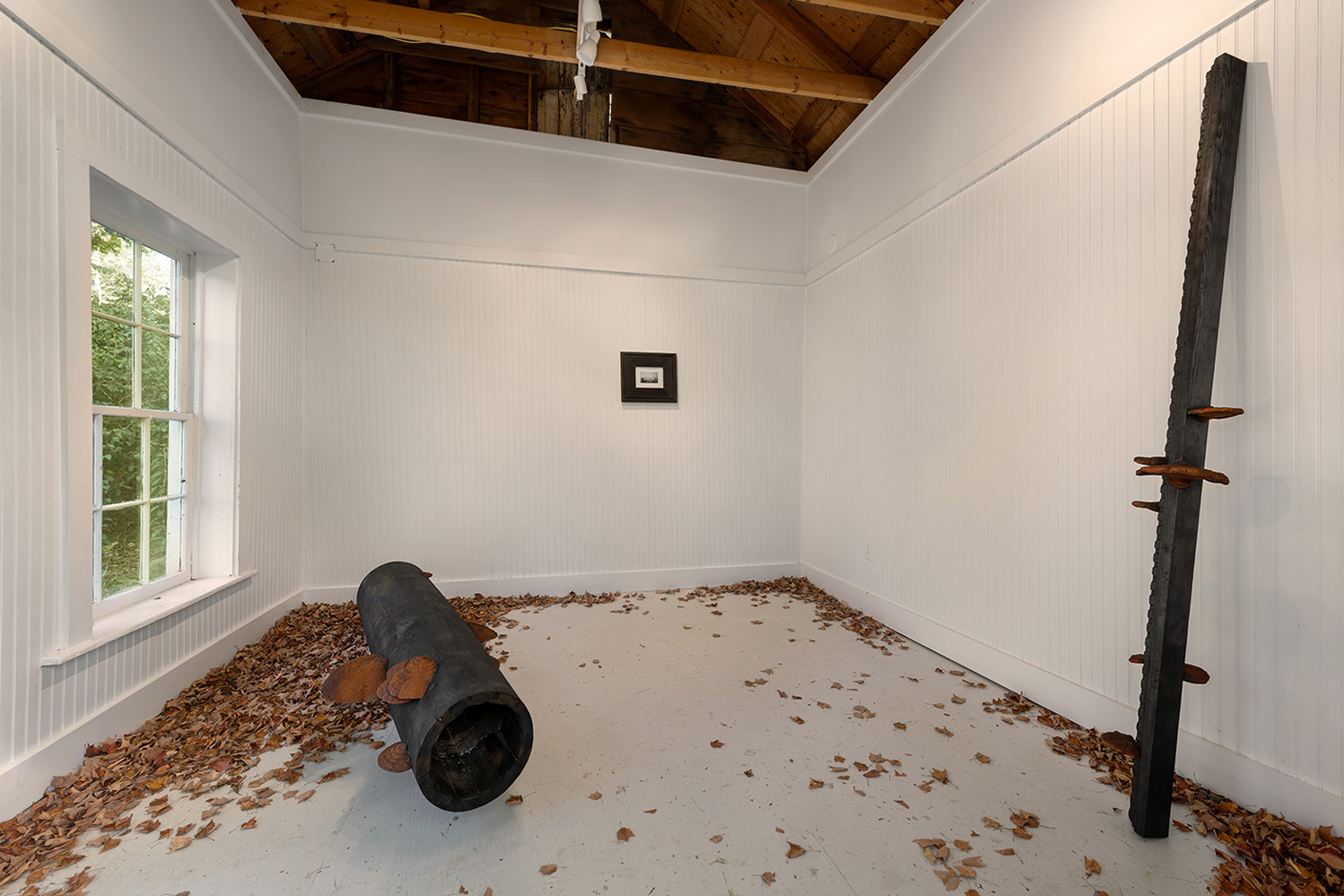
In 2020 I was invited to propose an exhibition for the ICEHOUSE Project Space in Sharon, Connecticut based on my interest in both history and geology. The resulting project, The Understory, was realized in 2021 after almost a year of research that focused on the eighteenth and nineteenth century iron industry in northwestern Connecticut.
From the exhibition’s accompanying publication:
In scattered locations in the Taconic and Litchfield hills of Connecticut and the adjacent areas of New York and Massachusetts the landscape holds hints of an enterprise that has largely been forgotten. Revealed by piles of firebrick and glassy slag, soil darkened by the remnants of charcoal, and the occasional rusty scrap of iron, these sites speak of the first great era of resource extraction following European colonization. The Understory is a contemporary response to this history, realized through the materials that comprised the early American iron industry.
Iron is the primary constituent of the Earth, comprising thirty-five percent of its mass. It is the Earth’s outer liquid iron core that creates the planet’s magnetic field, a barrier that protects the surface from solar radiation making life possible. Oxygen is transported throughout our bodies and most creatures with circulatory systems via hemoglobin, a protein which bonds oxygen to iron.
The iron deposits in northwestern Connecticut originated as iron-rich sediments that formed 485 million years ago in the Iapetus, the narrow sea that was the precursor to the Atlantic. Through the process of two continental collisions and the resulting uplift of the Appalachian Mountains the sediments were altered by heat and pressure into hematite, goethite, limonite and magnetite–the primary iron ores found in the region.
Iron was first discovered in Litchfield County in 1731 by surveyors Ezekiel Ashley and John Pell in Salisbury, and the first iron furnace was put into blast in Lime Rock in 1735. The period around the Civil War was the peak of iron production and the apogee of deforestation in northwestern Connecticut. On average, 600 acres of trees needed to be cut annually to create charcoal to fuel a single furnace. During the 161 years of the industry there were 22 blast furnaces smelting metallic “pig” iron from ore, 37 bloomery forges (a crude form of blast furnace) and 22 finery forges and puddling works that refined pig iron into wrought iron. Seventy percent of the forest in northwestern Connecticut was harvested for charcoal by the 1870s, resulting in much of the fertile topsoil washing into the region’s rivers and streams. Currently, Litchfield County is seventy-five percent forested.
In 1770 the British North American colonies became the world’s third largest iron producer, threatening the prosperity of English ironmakers. In 1776, Connecticut’s Committee of Safety seized the Lakeville Furnace to produce cannons for the Continental Army during the Revolution. The production of weapons during the war earned the region the title “Arsenal of the Revolution,” a distinction that continued into the nineteenth century and through to the Civil War. Northwestern Connecticut provided iron for a range of armaments and munitions and in 1864 the Ames Iron Works in Falls Village produced cannons for the Navy, including 13 guns capable of firing a 100 lb. ball over six miles.
The industry began to decline in the last decades of the nineteenth century due to missed opportunities to keep up with new technologies and with the discovery in 1890 of massive, high-quality iron deposits in northern Minnesota. In 1923 the East Canaan furnace shut down, marking the end of iron production in the region.
Despite the digital and green energy revolutions with their use of metals such as silicon, lithium, copper, and cobalt, iron is still by far the metal most frequently utilized by humans. By weight, only concrete surpasses iron in its ubiquity in the artifacts built by civilization. The technology to cast iron was first developed in China in the fifth century BC, slowly spreading west and reaching Europe in the early Medieval period. Cast iron, as opposed to steel, contains anywhere from two to four percent carbon, which gives it a low melting point (2,200° F), fluidity, and a resistance to deformation and oxidation. Carbon was added to the iron made in the region by the use of charcoal as fuel in the furnaces, with the resulting high-quality metal being dubbed “Salisbury Iron” in an early example of product branding.
By and large, the iron industry and its environmental impacts have faded from view, with only a handful of furnaces still standing. Most of the furnace sites are only marked by collapsing stonework, piles of firebrick and slag heaps that are quickly being subsumed back into the earth. The open-pit mines have filled with water and become lakes and the forest has largely grown back to reclaim the region’s hills and valleys. The once ubiquitous nature of the industry is frequently revealed through the numerous roads and brooks that dot the map with “furnace” in their names.
The Understory is composed of native iron and wood that has been reclaimed and repurposed, not as a historical recounting, but rather as a meditation on deep time and the cycles of both nature and civilization. The fungi, which have been directly burnt out of molds and cast in iron, come from trees in the northwestern hills of Connecticut, and the large, burnt wood form is a fragment of an architectural column from a nineteenth century house that was torn down in Canaan–a town whose economy was partially based on the iron industry. At the project’s culmination some of the cast iron fungi were returned to the furnace sites, where they are being allowed to slowly oxidize back into the landscape.
I am indebted to the knowledge and passion of many individuals who I either met or spoke to during the realization of this project, including Robert Gordon and Michael Raber, authors of Industrial Heritage in Northwest Connecticut: A Guide to History and Archaeology; John Pawloski, Curator of the Connecticut Museum of Mining and Mineral Science in Kent; Lauren and Josh Dow of the Green Foundry in Eliot, Maine; Elizabeth Shapiro, Director of Arts, Preservation and State Museums at the Connecticut Office of the Arts; and the late Ed Kirby of Sharon, whose book Echoes of Iron in Connecticut’s Northwest Corner was critical to my understanding of the subject. The title I’ve chosen The Understory owes a debt to Richard Power’s brilliant novel The Overstory, a powerful evocation of–and paean to–the natural world. I am extremely grateful to the friends and colleagues that helped with many aspects of the project from its inception, including Roger Brouard, Jacquie Littlejohn, Gretchen Kraus, and particularly my wife, Mary Kenealy. My special appreciation goes to KK Kozik, Curator of ICEHOUSE Project Space, whose invitation to consider an exhibition centered on art and geology led me down a fascinating path I might never have taken.

Rusted, cast iron Cracked Cap Polypore fungi, burnt nineteenth century wood architectural column.
15 x 25 x 72-½ inches

Offset lithograph, burnt wood frame, nineteenth century plate glass
14 x 15 ½ inches
Original photo in the collection of the Salisbury Association